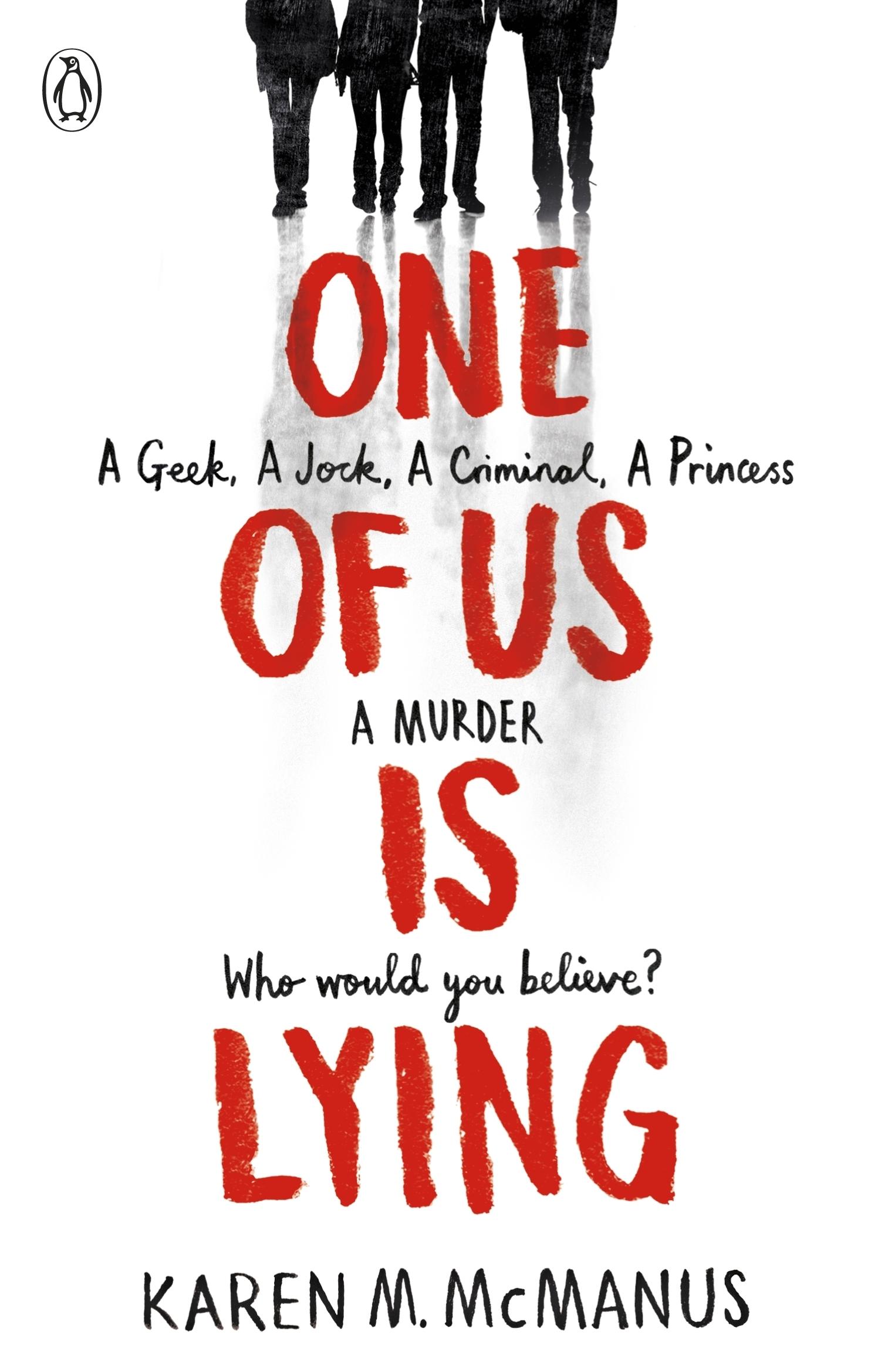

nerd teacher [books] reviewed One of Us Is Lying by Karen M. McManus
Engaging to Read but Incredibly Frustrating to Think About.
1 star
Content warning I will spoil the end because the ending is the most frustrating. Mentions of suicide, Christian apologetics.
To note: I started reading this book because it is one that a family I work with was asking me about, and it's a book that I've had sitting on my shelf for ages in a stack of books I ordered prior to COVID lockdowns for a school I used to work at and just... forgot to give back. ANYWAY.
Here's what I like about it: The book is fairly engaging in the writing, so it's pretty easy to knock out in a day or two (except for the final two or three chapters). Nate (the kid on probation) and Addy (the girl whose initial personality revolves around her boyfriend) are probably the best characters, and I think that is mostly by accident and not entirel by design (especially considering some complaints I have about how their stories are handled).
That's it.
Let's get one nitpicky complaint out of the way: I wish authors would learn how things work before incorporating them into a story. I hate that I have to correct the author on this one, but 4chan doesn't have registration unless you're staff; the Wikipedia even says that—plus, I checked archives of their FAQ as far back as 2016, and it has said the same thing for years about registration... that it's not available. I appreciate that the author wanted to use 4chan in 2017, especially as it had gained its notoriety by then of being one of the shittiest places on the internet and full of noxious creeps writing manifestos, people supporting school shooters, and nazis... But I also would appreciate if people learned how things work so one absurd detail doesn't make me go, "Wait, are you saying the guy who died was staff at 4chan?" (Apparently, after I asked someone else, I either had too many former friends who found their way there or am personally too online for knowing this.)
Oh, and another nitpicky complaint: The title itself is a lie. None of the characters we follow are lying (as implied by the title). Sure, two characters are lying, but then we wouldn't have a story if they weren't. The title implies it's the people we're with, and it's just obvious from the beginning that it's none of them. A corpse can't lie about his plan after the fact (unless it's by omission, I guess) because they're dead; the two living collaborators are lying, but we need them for the story that's been created (and we're not following them at all or ever), but they are "One of Us" because they were never in the room where the person died when it happened. The misleading title annoys me, and it feels like it's trying to riff badly on Agatha Christie (And Then There Were None without understanding why all of the titles for that book it worked).
A third nitpick: For the username of the kid who idolises school shooters, McManus chose "AnarchiSK" (SK for his initials—Simon Kelleher). As a result, I just want to beg authors to do one thing: Please stop using anarchism/anarchy as a fucking edgelord thing, authors? It's not creative. It's gross, especially as we're often targeted for our politics. Learn about anarchists before you go pretending it's an edgy ideology of people who want to engage in mass murders of children.
I'm not a fan of a lot of this book because there are some apologetics I don't think should be there, and there are a lot of Christian undertones (especially in the themes of forgiveness and shame) that bleed through the narrative that I think actually harm it. I also don't like the use of queer sexuality as a twist and a scandal, and I find the presentation of female sexuality to be rather harmful across the board.
Two characters are both presented as cheating on their respective partners (one girl does it one time, one guy does it for months), but the latter never gets called a cheater or slut-shamed in the way that the former does. Addy has to deal with people scrawling derogatory slut-shaming language on her locker and being physically assaulted by her former "friends" while they use derogatory slut-shaming language, and... this isn't really challenged that much in the narrative? The "challenges" are pretty meagre (one character giving her bandages after being tripped in PE, another who spends part of their lunch time with her until he goes back to their formerly shared friend group of mean girls and some jocks). I'm not expecting a direct call out to make it clear to the audience, but it'd still be nice to have a bit more in the narrative that gives Addy support. (I mean, for fuck's sake, the character is 17 years old. Someone should've, and could've, said something; I don't understand why McManus wouldn't even try to make that clear, especially since Addy undergoes the most change in a direction away from needing a relationship.)
Then there's Cooper. He's a jock with a ~scandalous secret~ (he's a closeted gay boy with a secret boyfriend... which isi not scandalous, no matter how McManus wanted to frame it as such). This is also the twist for Cooper's secret (we're told that he's juicing, which is a lie), and that is disappointing. Anyway, he's been cheating on his girlfriend for months with a guy, and this isn't presented as cheating. I can't tell if the reason the author thinks this is less cheating than the other is just because he's a male character (while Addy isn't), because he's gay (so he's really just using his girlfriend to hide), or because he and his girlfriend didn't have sex (which Addy and her boyfriend did). Anyway, once Cooper is outed to the whole school via a police investigation, they start harassing him for a day. This culminates in one character coming in to defend him... by slut-shaming another girl. Narratively, him going off on this girl is justifiable, but it's also bizarre that McManus could not find another way for him to fight against her besides having him say that she's basically messed around with every guy in the school.
So, like I said. Christian framing and apologetics.
Personally, I don't care that either of them are presented as badly handling relationships. I think badly handled relationships can be interesting parts of stories, especially in "young adult" fiction. These characters are teenagers, and it can be a fun place for actually existing teenagers to learn about and explore different ways of handling relationships (and sometimes handling things badly does teach you how to handle things better later). But I find it peculiar that McManus didn't see them as either doing something equally harmful to their relationships or with the one doing it for months actually doing something a bit more harmful than the other (especially since Addy's boyfriend is portrayed as controlling and abusive, while Cooper's girlfriend is just... very nice, so even the relationship dynamic is completely different).
Maybe the book could've been improved by Cooper and his girlfriend having a lavender relationship. That probably would've made it more interesting to me as a "scandal" on a school gossip site, honestly. If we have to forcibly out characters for the sake of a narrative, that is.
The tropes also got to me. I think it's fine to use tropes, but I think we need more attempts to break them down or at least be creative in their use. However, this book mirrors The Breakfast Club in a lot of ways, including having the characters openly and in the narrative acknowledge their High School Stereotype. While I don't love that movie, it makes sense there because a whole part of the movie is about those characters breaking down those stereotypes and working against them. That doesn't really happen here as much, with only Addy and Nate breaking from their respective stereotypes (unless "being gay" is antithetical to "being a jock", which is a huge assumption being made in this book). Bronwyn (the brainy and good girl) does nothing to break her stereotype except maybe get with Nate (the kid on probation), which literally is something that also happens in The Breakfast Club. I get the feeling that McManus thought she was breaking Bronwyn's stereotype with how much she hid from her parents and also helping Nate to get legal counsel after he was arrested despite her father's displeasure, but that doesn't even make sense because that's not what the stereotype is about.
The twist reveal of who actually killed the character in detention is that... it was himself. So the murder victim is actually a suicide, which was inspired by his desire to see a "more creative" school shooting. Basically, he wanted to frame four people for his murder and cause so many problems for them all for at least a full year. Three of these people he had claimed had "wronged" him somehow (Cooper had him disinvited to a party due to discomfort with what he thought were unwanted advances, Bronwyn was close to being valedictorian and had cheated in chemistry, and Nate had effortlessly hooked up with a girl at a party that he was into) and one of whom was selected by one of his collaborators (Addy was chosen so that her boyfriend could get vengeance on her for... cheating on him). This twist reveal is less of a twist because the writing for the characters being suspicious of each other is... not well done.
Around 90 pages in, and I had already started thinking that the person who died had killed themself or was involved somehow. Finding out that Abby's controlling boyfriend was in on it also felt less like a twist and more like an obvious fact, especially considering how often his appearances on page or other character's commentary on him just felt like red flags slapping you in the face. Just... ugh.
But the mental health portrayal? Disappointing. The person who died being depressed is so badly handled, along with the constant references to 4chan, school shootings, and being entitled to position or status. Perpetuating that bullshit makes me want to throw this book in the bin. And then there are characters who are forced to feel like they could've prevented this from happening if only they hadn't cheated on their chemistry exams or didn't disinvite them from a party due to discomfort from the guy's behaviours. It's such a bad framing, especially because it's challenged so little the whole time.