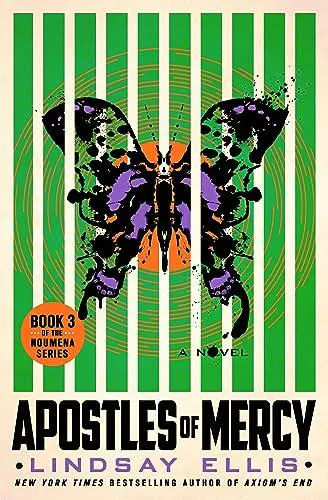

V171 reviewed Apostles of Mercy by Lindsay Ellis
None
4 stars
Thank you to the publisher for providing me an advance reader copy of this book in exchange for an honest review!
A new book, a new conflict, new characters, but a familiar threat looms. Apostles of Mercy shifts the lens back away from humanity which was largely the focus of Truth of the Divine, and back to the aliens (but with a twist!). While I preferred this perspective and found the story to be interesting, as the end of a series, it left me scratching my head.
I'm writing this review to hide spoilers for this book, Apostles of Mercy, but I'm not going to attempt to hide spoilers for the previous books, so please be warned. It's too difficult to review this book series while hiding every single thing that could possibly be a spoiler for all three books, so be aware that spoilers for both Axiom's End and …
Thank you to the publisher for providing me an advance reader copy of this book in exchange for an honest review!
A new book, a new conflict, new characters, but a familiar threat looms. Apostles of Mercy shifts the lens back away from humanity which was largely the focus of Truth of the Divine, and back to the aliens (but with a twist!). While I preferred this perspective and found the story to be interesting, as the end of a series, it left me scratching my head.
I'm writing this review to hide spoilers for this book, Apostles of Mercy, but I'm not going to attempt to hide spoilers for the previous books, so please be warned. It's too difficult to review this book series while hiding every single thing that could possibly be a spoiler for all three books, so be aware that spoilers for both Axiom's End and Truth of the Divine are below.
After the events of the last book, Cora is picking up the pieces of her life yet again. After Kaveh's death Cora develops a relationship with Paris as well as continuing to develop a deeper bond with Ampersand. As a result of events from the last book, Ampersand now lives in Japan which has extended rights to extraterrestrials, and Nikola has been forcefully imprisoned due to him trying to kill both Ampersand and Cora. It's discovered that the amygdaline sister species, the physterines, are on Earth and have been for decades, hiding from the Superorganism, trying to survive. While the exiled amydalines, the Fremda group, the physterines, and humanity all have a common goal in eluding the Superorganism, that doesn't mean they can work together as Ampersand is dead set on killing the physterines and the physterines are ready to claim Earth as their own. When their presence is found out, the physterines don't hesitate going on the offensive, capturing Nikola and Paris as Cora and Ampersand desperately try to get them back. It takes our full cast of characters, including CIA agent Sol and even Cora's awful father Nils to prevent the end of humanity, but with the multiple different parties trying to protect their own safety, how will humanity come out on top?
Just trying to recap this book made me realize that perhaps it wasn't as structurally sound as I had thought going into it. There are a lot of moving parts here, and unfortunately I feel that some of the development of these story lines was lacking because there was just so much that the story was trying to do.
Let's start with the characters. Okay so we have Cora and her relationship with Ampersand. It's mostly trucking along as usual, but now he wants to teach her high language, an invasive merging of consciousnesses, and it freaks Cora out, but he's insistent. Little bit of tension there.. Then there's her relationship with Sol, which is weird because it didn't exist in the second book so I hardly remember how I'm supposed to feel about him, but it's tense and strange, but I feel like I was meant to be rooting for it? Then there's Cora's relationship with Paris, which was very insta-lovey and mostly developed off page which made it harder for me to understand their deep connection. And then there are the smaller relationships, Cora and Nils, Paris and Nikola, Sol and Nils, Cora and Luciana, Paris and the physeterines , Ampersand and the Fremda group.. There was a primary conflict that drove the narrative for the majority of this book, but there was SO MUCH relationship development that felt like it was hastily included for some reason, I wish more attention had been put on fleshing out the relationships most critical to the story rather than worrying about wrapping up every single relationship before the end of the series.
The main story was very good, extremely compelling. The threat of the physeterines was so fascinating and the author did an excellent job of making it supremely difficult at figuring out who to "root for". The physeterines are just refugees and trying to survive, farmers trying to make their way in a universe trying to kill them, but they want to destroy humanity to have the planet for their own. Humanity is trying to survive by fostering good relationships with both the amygdalines and the physeterines who are dead set on killing each other, but they won't hesitate to destroy either one to protect themselves, and typical humanity will always go with the genocide option. The amygdalines are also trying to survive and navigate their new place on Earth, but seem to have no mercy for the physeterines and want them eliminated at all cost for their own survival. Almost with each chapter, your feelings towards any of these factions shifted and waned, driving you to hope that somehow all of them get what they want. While I found the pacing to be strong, it was a bit jarring for the narrative to shift so strongly from the second book to the third. The second book was almost entirely about humanity's acceptance of the aliens, and that was all but abandoned in this book. I personally prefer the focus on the aliens, but it did feel strange to leave that story behind so suddenly.
As a book, this was fine, probably 3 stars or so. With so much going on in the story, I feel like the characters and relationships were left behind and I prefer character work to plot honestly. But as the conclusion of a book series, it's much more compelling. Each book was so different and novel in its own way. While Axiom's end could be thought of as another first contact story, it is so much more than a "chosen one girl bonds with an alien and they go off on adventures". It is deeply political and scary. The second book pivots hard into the global politics of what it would mean to encounter super intelligent aliens and how to protect them while also protecting your own species. And then the third book kind of pivots into galactic politics and finding your place in the universe. Each book was a totally unique take on what first contact might mean, and I thought it did a fantastic job of really exploring those themes. So while there could be improvements at the book level, I really appreciate what this series did as a whole and I thought it was a refreshing take in the first contact genre.