Few books on software project management have been as influential and timeless as The Mythical Man-Month. With a blend of software engineering facts and thought-provoking opinions, Fred Brooks offers insight for anyone managing complex projects. These essays draw from his experience as project manager for the IBM System/360 computer family and then for OS/360, its massive software system. Now, 20 years after the initial publication of his book, Brooks has revisited his original ideas and added new thoughts and advice, both for readers already familiar with his work and for readers discovering it for the first time.
The added chapters contain (1) a crisp condensation of all the propositions asserted in the original book, including Brooks' central argument in The Mythical that large programming projects suffer management problems different from small ones due to the division of labor; that the conceptual integrity of the product is therefore critical; and that …
Few books on software project management have been as influential and timeless as The Mythical Man-Month. With a blend of software engineering facts and thought-provoking opinions, Fred Brooks offers insight for anyone managing complex projects. These essays draw from his experience as project manager for the IBM System/360 computer family and then for OS/360, its massive software system. Now, 20 years after the initial publication of his book, Brooks has revisited his original ideas and added new thoughts and advice, both for readers already familiar with his work and for readers discovering it for the first time.
The added chapters contain (1) a crisp condensation of all the propositions asserted in the original book, including Brooks' central argument in The Mythical that large programming projects suffer management problems different from small ones due to the division of labor; that the conceptual integrity of the product is therefore critical; and that it is difficult but possible to achieve this unity; (2) Brooks' view of these propositions a generation later; (3) a reprint of his classic 1986 paper "No Silver Bullet"; and (4) today's thoughts on the 1986 assertion, "There will be no silver bullet within ten years."
The Mythical Man-Month is a collection of classic papers on software engineering, with some additional commentary (particularly in the 1995 edition) and connective tissue to turn them into an approachable narrative. It dates from a time when software engineering consisted of moderately large teams of programmers working on software packages written mostly in assembly or machine language for mainframe and minicomputers. The majority of the essays in the book are from the author’s experience on the OS/360 operating system project for IBMs enormous System/360 mainframe computer. At the time, OS/360 was one of the (or possibly the) largest software development efforts ever attempted.
While the above description makes it sound like the Mythical Man-Month is as dated as the woodcut of a mammoth struggling in the La Brea tar pits found on its cover, the author did an amazing job of extracting insights about software development that not only stand …
The Mythical Man-Month is a collection of classic papers on software engineering, with some additional commentary (particularly in the 1995 edition) and connective tissue to turn them into an approachable narrative. It dates from a time when software engineering consisted of moderately large teams of programmers working on software packages written mostly in assembly or machine language for mainframe and minicomputers. The majority of the essays in the book are from the author’s experience on the OS/360 operating system project for IBMs enormous System/360 mainframe computer. At the time, OS/360 was one of the (or possibly the) largest software development efforts ever attempted.
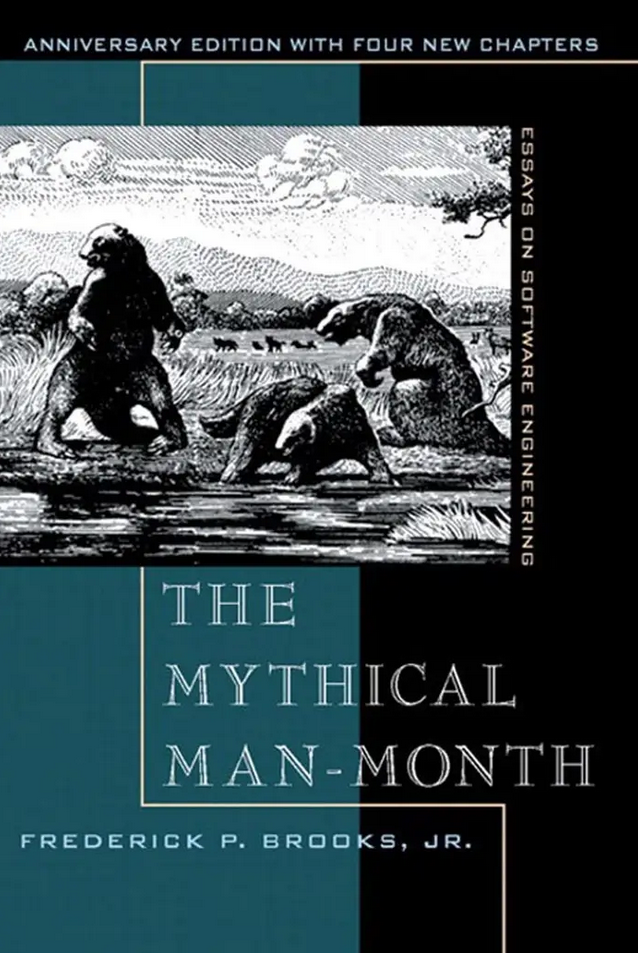
While the above description makes it sound like the Mythical Man-Month is as dated as the woodcut of a mammoth struggling in the La Brea tar pits found on its cover, the author did an amazing job of extracting insights about software development that not only stand the test of time, but also apply to much smaller projects — including projects of the scale that students are likely to encounter in their classes. It is sprinkled throughout with observations and aphorisms that are immediately useful. The most famous of these is probably Brooks’s Law, which states that “Adding manpower to a late software project makes it later.” For my own part, I find the observation “Plan to throw one away; you will, anyhow” to be my favorite advice in the book.
In addition, Brooks’s description of the The Joys of the Craft of software development in Chapter 1 is one of the most beautiful summaries of the field that I have ever read. I will leave you with this quote:
Yet the program construct, unlike the poet's words, is real in the sense that it moves and works, producing visible outputs separate from the construct itself. It prints results, draws pictures, produces sounds, moves arms. The magic of myth and legend has come true in our time. One types the correct incantation on a keyboard, and a display screen comes to life, showing things that never were nor could be.
Review of 'The Mythical Man-Month' on 'LibraryThing'
5 stars
This book was written in the sixties, yet, I find its recommendations and requirements for software development are just as helpful, humorous and educational in the 21st century. I still don't understand how they got any work done back then with manually teletypes, printed requirements documents being updated everyday and the like, but they still had the exact same problems we do now. returnreturnThe two things I took away most, "the more people you add to a late project, the later the project is." Along with the title of the mythical man month, is the idea "nine women can't make a baby in a month." The other point, was that whatever your estimate is for development time, you need to consider at least twice as much for validation. This is counter intuitive, you develop it once, you test it once, and that test takes less time than writing code did, …
This book was written in the sixties, yet, I find its recommendations and requirements for software development are just as helpful, humorous and educational in the 21st century. I still don't understand how they got any work done back then with manually teletypes, printed requirements documents being updated everyday and the like, but they still had the exact same problems we do now. returnreturnThe two things I took away most, "the more people you add to a late project, the later the project is." Along with the title of the mythical man month, is the idea "nine women can't make a baby in a month." The other point, was that whatever your estimate is for development time, you need to consider at least twice as much for validation. This is counter intuitive, you develop it once, you test it once, and that test takes less time than writing code did, but there is so much more. The covers testing for each release, it covers finding regressions later, and any other issue that may be written against that piece of code that wasn't exposed when it was first authored. These good testers make bug fixing much easier.