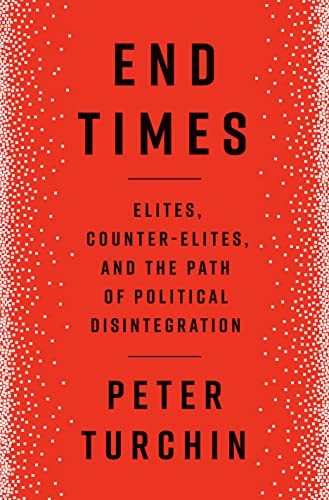

Sally Strange reviewed End Times by Peter Turchin
An interesting read but beware the author's hubris
3 stars
I realized about 2/3 into this book that I had gotten Turchin confused with Tainter. Joseph Tainter is an archeologist and historian who wrote "The Collapse of Complex Societies" in 1988. Peter Turchin is a biologist and mathematician who decided to mathematize the field of history by creating a massive database of historical data and analyzing it for trends. He calls this "cliodynamics." Turchin made the news because he (said he) used his cliodynamics database to predict, in 2010, that the 2020s would be a period of political turmoil in the USA. Cool and all, but it's not a difficult prediction to make if one is aware of US politics and climate chance science. This lent cliodynamics an air of scientific validity, but the jury is out on whether that field is a valid one or not. It's impossible that any database of historical events could be complete and accurate …
I realized about 2/3 into this book that I had gotten Turchin confused with Tainter. Joseph Tainter is an archeologist and historian who wrote "The Collapse of Complex Societies" in 1988. Peter Turchin is a biologist and mathematician who decided to mathematize the field of history by creating a massive database of historical data and analyzing it for trends. He calls this "cliodynamics." Turchin made the news because he (said he) used his cliodynamics database to predict, in 2010, that the 2020s would be a period of political turmoil in the USA. Cool and all, but it's not a difficult prediction to make if one is aware of US politics and climate chance science. This lent cliodynamics an air of scientific validity, but the jury is out on whether that field is a valid one or not. It's impossible that any database of historical events could be complete and accurate before roughly 500 years ago (generously), so the question of whether the inputs to the cliodynamic predictive algorithm are worth anything is very much wide open.
That said, Turchin has a thesis that wealth pumps (societal arrangements that funnel resources from the general population into the pockets of the already wealthy and powerful) are bad because they inevitably lead to "elite overproduction" (when there are more rich failsons than there are seats in the Senate or boardroom) and "popular immiseration," (when everyone else is getting poorer and unhappy) and when you have both of those things, unrest and revolution can't be far behind. The wealth pump concept is traced to Piketty's work, but elite overproduction and popular immiseration as causes of unrest are Turchin's original observations. These are interesting and probably at least generally accurate. The 30,000 ft view of history through that lens taken by the book is definitely food for thought.
Turchin's conclusions leave a lot to be desired, though. He's generally unconcerned with the suffering inflicted by an existing system and seems to regard revolutions as inherently bad, thus he praises the British Empire and the Russian Czars for bending partially to the demands of their unhappy, protesting citizens. Such elite compromises, he says, can prolong the life of an empire, as if that's something we should all desire and work towards. I'm not convinced.
Overall not a boring read but skepticism should be applied liberally.